
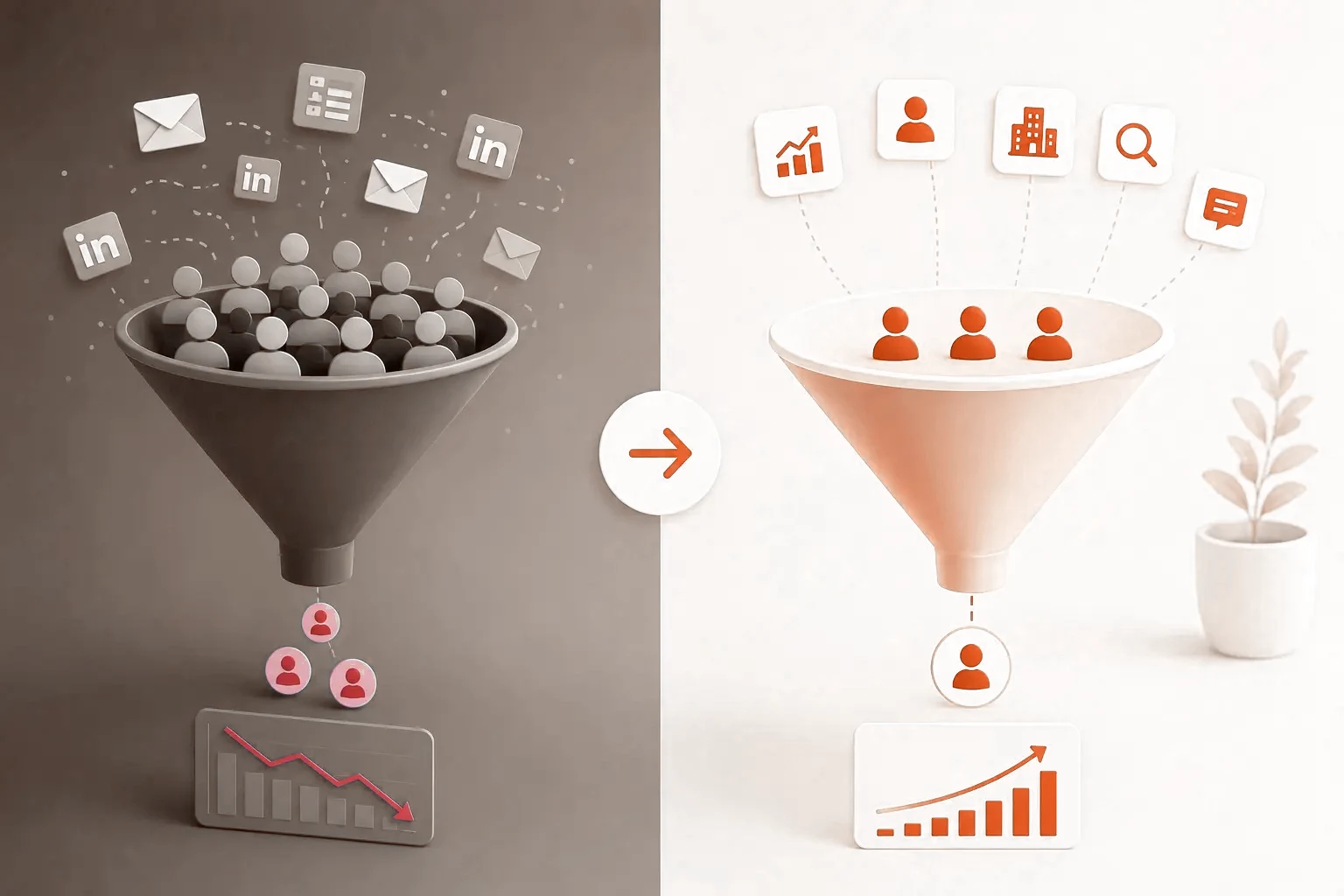
Most outbound systems are producing activity, not pipeline
A large number of IT service companies still approach outbound with the same operational mindset:
- Pull random lists from prospecting tools
- Push thousands of contacts into sequences
- Send bulk cold emails
- Automate LinkedIn outreach at scale
- Hope someone responds
The dashboards look active. Emails are being sent. SDRs are completing tasks. LinkedIn activity is increasing.
But behind the surface, most founders are dealing with the same operational frustration:
- Low quality replies
- Inconsistent meetings
- Weak conversion rates
- Burned email infrastructure
- SDR inefficiency
- Unpredictable pipeline generation
The issue is not effort. The issue is that most outbound systems were never designed around buying intent in the first place.
The hidden problem most founders discover too late
Many outbound teams still qualify accounts using static filters: industry, company size, geography and job titles. But none of these factors indicate whether a company is actually prepared to buy.
A CTO matching your ICP does not automatically mean they have urgency. A funded company does not automatically mean they are evaluating vendors. A growing team does not automatically mean there is operational pain severe enough to create movement.
This creates a dangerous outbound pattern. Teams keep increasing volume because conversion quality remains low. So the response becomes more emails, more automation, more SDR activity, more sequences and more databases.
Eventually the infrastructure itself starts degrading. Deliverability weakens. Domain reputation declines. Open rates collapse. Good prospects stop seeing the emails entirely.
Why traditional outbound is becoming less effective
Buyers today are overwhelmed with outbound noise: generic cold emails, mass LinkedIn messages, automated follow ups and AI generated personalisation that feels artificial.
The market has adapted to this behaviour, which means volume alone no longer creates attention. Timing does. Relevance does. Operational context does.
The strongest outbound systems today are not trying to contact everyone. They are trying to identify the small percentage of accounts already showing movement. That changes the entire outbound equation.
The shift toward intent driven outbound systems
Modern GTM teams are beginning to treat outbound differently. Instead of building workflows around contact databases, they are building workflows around signals, identifying companies that are:
- Hiring aggressively and expanding departments
- Adopting new technologies
- Increasing operational spend
- Discussing active pain points publicly
- Entering transformation cycles
This is where AI agents and workflow automation start to create real operational value. Not because AI replaces SDRs, but because AI helps filter noise before human outreach begins.
That single shift changes outbound performance dramatically. Smaller lists. Higher intent. Better conversations. More qualified meetings.
AI is becoming a qualification layer, not just an automation layer
Most companies currently use AI for content generation. Very few use it well for outbound qualification. The real opportunity sits earlier in the pipeline. AI systems can now help identify buying signals, operational bottlenecks, team expansion patterns, technology shifts, service gaps and market movement indicators.
This lets outbound teams prioritise accounts by likelihood of movement instead of static database criteria. The result is efficiency at every stage:
- SDRs spend less time on low probability accounts
- Messaging becomes more contextual
- Outreach timing improves
- Deliverability risk decreases
- Pipeline quality increases
Most importantly, teams stop confusing activity with progress.
The infrastructure layer most companies ignore
One of the biggest mistakes in outbound today is treating deliverability like a technical setup task instead of a revenue function. When poorly qualified outreach runs at scale, infrastructure damage becomes inevitable: domain reputation decline, spam placement, inbox throttling and lower engagement.
Even strong messaging fails once the infrastructure weakens. Modern outbound systems need disciplined architecture:
- Multi domain setups
- Controlled sending environments
- Inbox rotation
- Reputation monitoring
- Intent filtered targeting
- Clean enrichment workflows
Without this foundation, scaling outbound usually creates more operational inefficiency, not more pipeline.
The future of outbound belongs to operational intelligence
Outbound is not disappearing. But blind outbound is becoming increasingly expensive. The companies generating predictable pipeline today are not necessarily sending the most emails. They operate with better qualification, stronger intent visibility, cleaner infrastructure, more disciplined targeting and context aware workflows.
That creates a completely different pipeline environment. Less noise. Less wasted effort. Better timing. Better conversations.

B2B outbound architect. I help founders build pipeline systems that put qualified decision makers on their calendar.
Connect on LinkedIn →